
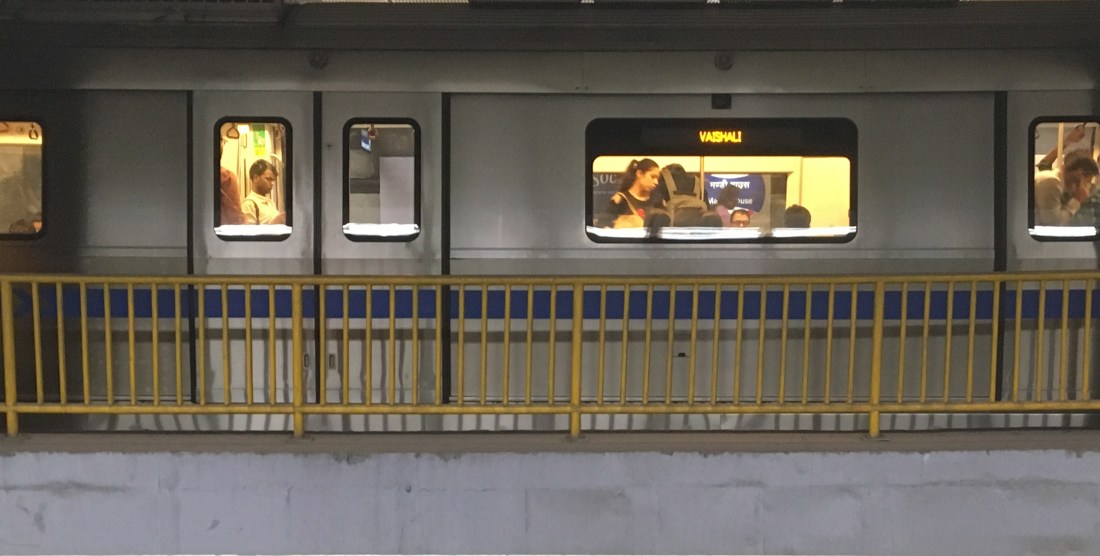
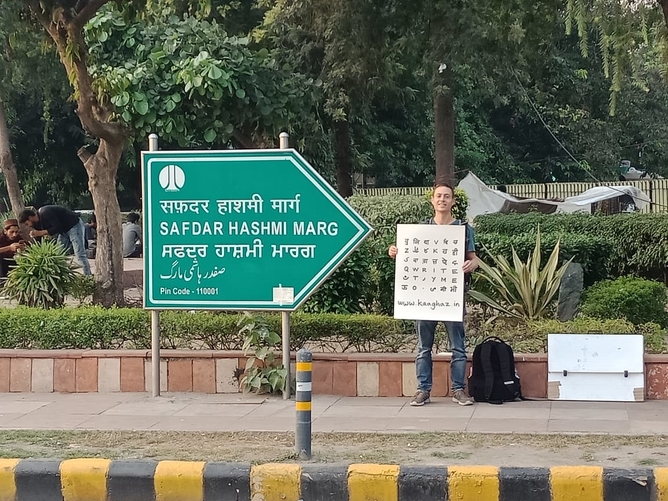
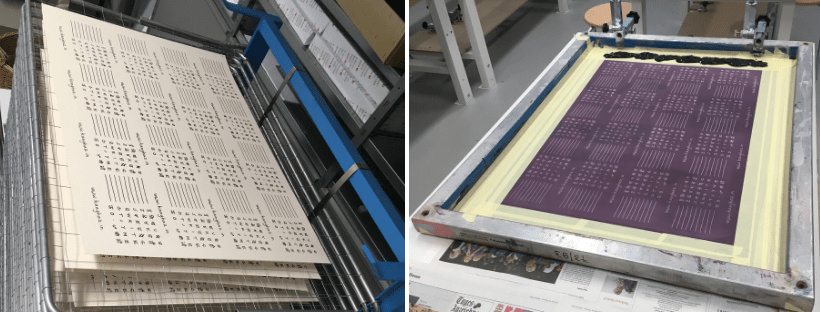
We spent a week moving around Delhi, armed with chalk and a djembe, putting up our puzzle and talking to people about scripts.
Take M for instance – he hails from Amritsar, Punjab and now works in Delhi. He reads Punjabi in Gurmukhi script, Hindi and English. His connection to Urdu is an interesting one.
In 1947, M’s grandmother migrated to Amritsar from across a newly-formed border that divided the country. In pre-partition Punjab, Urdu script was common in public spaces and generally taught in schools. Even Rajinder Singh Bedi, the great writer of the Progressive Writers’ Movement, received his formal education in Urdu like many Punjabis of his generation. This explains how M’s grandmother, too, can read and write Urdu. The later generations of the family, brought up in India, do not.
Punjabi is written in two scripts, Gurmukhi and Shahmukhi. Shahmukhi is the Perso-Arabic script used to write Punjabi, and today it is widely used in Pakistan. Gurmukhi on the other hand is commonly used in India. So M and his grandmother speak the same tongue, but they, like millions of people on different sides of the Punjabi border, read and write this language in different scripts. Earlier this year, Panjab University in Chandigarh brought out a proposal to begin diploma courses in Shahmukhi in an attempt to “break these barriers” and “learn more about our heritage”.
And Delhi is deeply embedded in Punjabi culture. A large number of families came as Partition refugees. Many other Punjabi families set up roots in the capital much earlier than 1947. Still others migrated later, and many continue to move to the city today. And so Delhi holds histories within histories – in the people we meet, in the tongues we speak, in the words we can and cannot read.
Face to face interactions
When I see words, they trigger an audio response in my mind, even if I can’t understand their meaning. Languages carry histories and cultures embedded within them. One of the reasons that Delhi feels so dynamic to me is that it has such a complex voice – like an ensemble, not a chorus. So many histories and cultures are here, and evidence of the various cultures is everywhere. I first visited Delhi over a year ago and the hand painted text that covers lorries, autos, walls and shops has a warm, welcoming aesthetic to me. Every surface of the city is alive!
I wanted to try to understand the character of Delhi. What can I learn about the culture from the mix of languages that exist here? How do people view the languages of their city which they don’t speak? Several English turns of phrase come to mind which indicate the importance we sometimes associate with being able to read and comprehend our surroundings: ‘we’re all on the same page now’, ‘we’re singing from the same hymn-book’. Other turns of phrase allude to our discomfort with the unknown ‘We’re in the dark’.
While we were developing our art project, we had the opportunity to present our idea to a gathering of academics and artists. One professor illustrated a sense of apprehension he attributed to being unable to comprehend his surroundings. He suggested that if he were placed in a labyrinth, he would need a string to help him navigate. Without a string he would be lost. The string that helps him navigate Delhi is common language. The implication was that without a common language, we are strangers, unable to help one another.
I want to share one small example of one of the many face to face interactions instigated by Kaaghaz. We visited Mandy house with handfuls of postcards and rolls of posters in a backpack for our first afternoon of distributing the puzzle. I wondered how our idea was going to be received.
Two students were sitting on a bench, chatting in Hindi and smiling at photos on their phones.
‘Excuse me, do you understand Hindi?’
‘Erm, yes, and English too’
‘Then you should be good at this… it’s a language puzzle.’
They looked at me for a few long moments suspiciously. When they gathered that I was not a salesperson, they took a postcard I was handing them. After a few seconds they located a Hindi word. “Duniya!”
“Yes!”
They proceeded to identify the English and Hindi words with ease, I sensed the feeling of pride they had in having their abilities challenged and confirmed by the action of solving the puzzle. Two Hindi words identified! One English word, two English words– on a roll!
The next word didn’t come as fast. Slowly, their sense of accomplishment started to diminish as they recognised languages that they could not comprehend. They had reached the extent of their autonomous problem solving skills. Lost, without a string.
‘We don’t understand these languages.’
‘That’s right, you won’t be able to solve this puzzle on your own’.
At that moment, the couple scanned the people around us, looking for help. A large group of young men wearing traditional Islamic clothes and speaking Urdu walked past us. One of the two students jumped up and approached the group, puzzle in hand, and entered a conversation with them, seeking to solve the Urdu words. Chatting in Hindustani, they solved 3 out of 4 languages. Do the words fit together? Is there a connection? New questions began to arise. Eyes began scanning for people who might speak Punjabi.
During the first afternoon of the project, these postcards had facilitated a conversation between a native English speaker, two native Hindi speakers and a group of native Urdu speakers. I was happy to be a part of this interaction. An enactment of getting lost and problem solving the way out of it. In this case, the string to guide the way out of the labyrinth wasn’t a map, it was asking for directions.
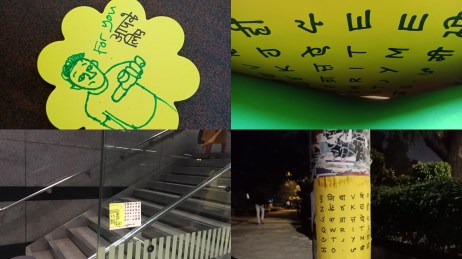
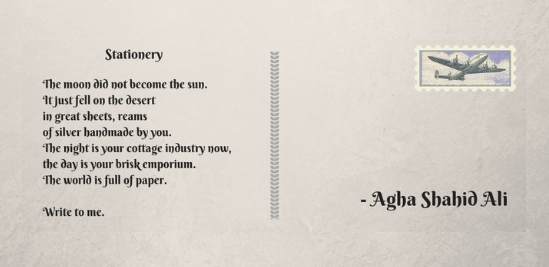
 کاغذ ਕਾਗ਼ਜ਼ काग़ज़ Kaaghaz